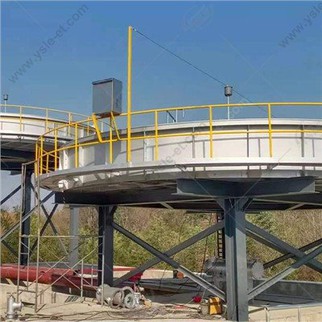
Air is introduced into the wastewater to produce a large number of fine bubbles. These bubbles can be produced by a dissolved air system in water and then released through reduced pressure.
These fine bubbles adhere to suspended solid particles or hydrophobic solid particles in the wastewater. This adhesion is caused by the interfacial tension between bubbles and particles.
After the air-floating particles adhere to the bubbles, their overall density will be smaller than that of water, so they will float to the surface of the water to form a scum layer.
The scum layer is scraped off, thereby achieving the process of solid-liquid or liquid-liquid separation.
Throughout the process, the flotation method utilizes the adhesion between fine bubbles and suspended solid particles, as well as the buoyancy brought by the bubbles, to achieve effective separation of suspended solids. This method is particularly effective in treating wastewater containing tiny suspended particles, and has simple equipment, small floor space, and convenient operation and management. Therefore, it has been widely used in water supply, industrial wastewater, and urban sewage treatment.